I’ve always had that simple curiosity. I look at something, and I want to know the basic concepts of how it works. I took toys apart when I was kid – just to see what was on the inside. What made it do its “thing”? I wasn’t nearly as good at putting them back together at first. And I wasn’t all that graceful in getting them apart either. I remember taking a hammer to a Speak-and-Spell just to get to the inside. And I remember my dad taking a belt to me as punishment for not having value for my toys. But this isn’t about the merits or drawbacks to corporal punishment, therefore I have accomplished my moment of digression. (And everyone either rejoiced or groaned)
This desire to see the internal workings of devices continued into the next parts of my life. During high school, I was fascinated by car engines, but couldn’t grasp the inner workings of such devices as carburetors. The internal wiring of houses was likewise fascinating, but the installation of the material proved to be far beyond boring for me and my interest quickly evaporated. There was this one place in my high school that I liked going to hang out though. The computer lab.
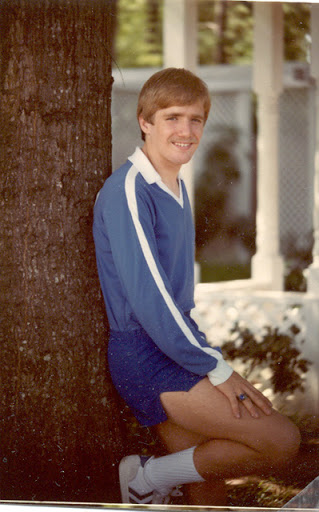 The computer lab wasn’t much. Back in 1982, personal computers were still fairly expensive – even for a school budget. There were two computer systems in the lab. One was a Texas Instruments TI-99/4A, which was the prime attraction for all my classmates. It was also really weird, but the computers seemed to only attract the attention of the Sophomores and Freshmen of the school (I was a Sophomore) – I’ve never been able to explain that (and here is my second digression). The other computer was an Apple ][ system. No one liked working with this system, because it didn’t have the absolutely cool driving program with the really different paddle input. Thus, there was always a huge crowd around the TI-99/4A.
I’ve never been comfortable in crowds (this is background, not digression). If one forms around me, I tend to try and step closer to the edges where possible. And ya’ll wondered why I named the podcast “From the Edge of the Circle” – grinning (and that was digression). This instance in the computer lab was no different. The computer lab wasn’t very large either. In another – very recent – life, this area was a place where faculty members picked up their inter-office mail and processed their scantron-administered tests. All of that had been moved to the larger faculty lounge on the other side of the school building – and this room had been created as a place to showcase these two systems to students. At any given time, there could be fifteen to twenty-five students in this cramped space – and like I said, everyone was crowded around watching a single person playing a game on the TI-99/4A. With crowds like that, my tendency was to move towards the back of the room – which was where the Apple ][ was located.
It was a boring system – especially since it didn’t have any games installed on it. Of course, none of us had any idea about the concept of installing software or even what a floppy disk was. We vaguely had an idea of how to type “go” into the system to run the driving game. But my curious nature soon had my attention away from the TI-99/4A and on the Apple ][. After a few minutes, I had figured out how to power on the system. But with no idea what to do next – all I had was a screen to stare at. A few days after I started to be fascinated by the machine – the Principal of the school – Dr. Thomas Doyle – saw my interest in the machine and helped me figure out how to start the Word Processing program. He knew a little more about the system than I did – but as it turned out, it wasn’t much. Everyone in the room was floored that the Apple ][ could do something, but their excitement quickly waned when they realized it wasn’t a game.
For me, it was a gift straight from the Gods. The Word Processing program allowed me to practice my keyboarding skills. Which helped me achieve speeds that Sister Mary Carmal (yes that was her name) never thought I would manage while I stubbornly stuck with the hunt and peck method of typing. With practice at the Apple ][ – I soon perfected a hunt-and-peck method that had me typing at 37 words per minute with no errors. In the military, I upped that to nearly fifty-three words per minute with no errors. Practice does make perfect. (Its a slight digression – still its background!) After a few months of me spending two to three hours in the lab (my mother worked into the early afternoon and couldn’t pick me up from school until nearly four hours after class – I had to have something to keep me out of trouble), Dr. Doyle eventually handed me the computer’s manual and told me to learn more about the machine. Soon after, I was in his office with the ultimate question to sate my curiosity.
Can we open it?
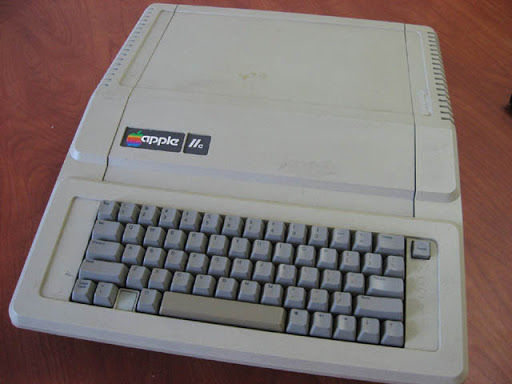 We moved after that school year. From Montgomery, Alabama to Shreveport, Louisiana. From the co-ed world of Montgomery Catholic High School to the all-boys environment at Loyola College Preparatory School for Boys. From a school environment where I could wear t-shirts and jeans to one where I wore slacks, a polo-shirt and dress shoes in the warm months – and slacks, shirt-and-tie and a blazer in the warm months. Where all of us dressed nearly alike – there was no allowance for individuality. And there was an entire classroom of Apple //e computers. Which we could only play games on after school – and were disciplined severely when we had the nerve to open the casing. Here was where I went from pure curiosity to sharpening my desire to be myself. In other words, I learned rebellion. But that’s another story for another time.
 Life With Trickster Gods